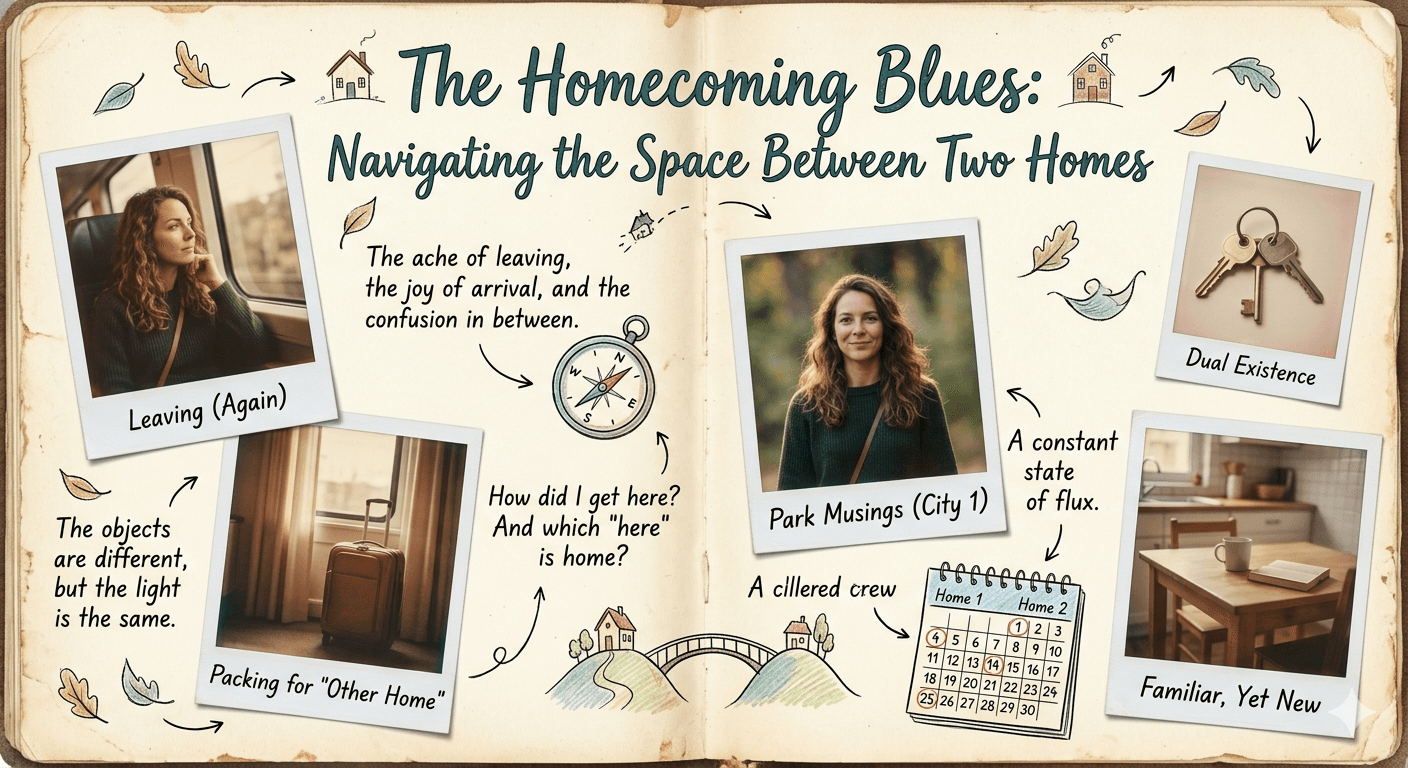
The Homecoming Blues: Navigating the Space Between Two Homes
You landed with your heart already racing, half anticipation, half something harder to name. This was supposed to feel like home. And in some ways it does, the language settling back into your mouth, a smell that unlocks a memory you didn't know you still had. But somewhere in the visit, a stranger's distance creeps in too. You don't quite fit here anymore, not the way you used to, and the realization aches in a way that catches you off guard. This is the Homecoming Blues, and it is one of the least talked-about parts of the immigrant and diaspora experience.
A Real, Studied Phenomenon
Psychologists studying migration and cross-cultural adjustment have long documented what's sometimes called reverse culture shock, the disorientation that can occur not when arriving somewhere new, but when returning to a place you once called home and finding that both you and it have changed. For diaspora communities, this can be even more layered: the motherland has moved on without you, your own identity has been shaped by the country you built a life in, and neither place fully claims you the way it once might have. The grief in this experience is real, even when the trip itself was joyful.
What This Often Feels Like
The Homecoming Blues can show up as:
• Being told you've changed, or sound different, by family and friends in your country of origin
• Feeling like a tourist in a place that is supposed to be home, unsure of customs that used to be second nature
• Grief for a version of the place, or yourself, that no longer exists quite the way you remember it
• Guilt about how much easier or harder your life has become compared to those who stayed
• A confusing low mood after returning from a trip that, on paper, should have felt entirely positive
Holding Both Truths
The most sustainable way through this experience is not choosing a side, deciding once and for all which place is really home, but learning to hold both truths simultaneously: you belong to more than one place, imperfectly, and that is not a failure of belonging. It is simply what it means to live a life shaped by more than one culture. Naming this experience out loud, rather than carrying the confusing sadness silently, is often the first real relief many people find.
When It's Your First Trip, Not a Return
For children of immigrants visiting a parent's homeland for the first time, this experience takes a slightly different shape. There is no memory being disrupted, since there was no prior version of the place to compare it to, but there is often a quieter, equally real disorientation: standing somewhere you were raised to think of as home while feeling, unmistakably, like a visitor there too. This can bring up complicated questions about identity and authenticity that deserve space, not dismissal. You do not need a lived memory of a place to feel a real, legitimate connection to it, and you also do not need to feel fully at home there for that connection to matter.
Visual & Formatting Notes (for design team)
Travel-journal layout throughout, using a scrapbook or journal-page visual metaphor. Polaroid-style photography with handwritten-style captions to reinforce the personal, memory-driven nature of the topic. Warm, slightly nostalgic color grading rather than crisp, modern photography.
Frequently Asked Questions
Is it normal to feel sad or disoriented after a trip home?
Yes. This is a well-documented experience, sometimes referred to as reverse culture shock, and it is a normal, common response to the complexity of navigating identity across two places over time.
Does this only happen on the first visit back after moving away?
No. Many people experience this on repeated visits, sometimes even more intensely over time as both they and their home country continue to change independently of each other.
Can therapy actually help with something so tied to identity and place?
Yes. A therapist familiar with immigrant and diaspora experience can help you process this grief and complexity without rushing you toward a simple resolution that doesn't reflect the real nuance of your experience.
Related Reading
• Acculturation Stress: Living Well Between Two Worlds
• The Language of Healing: Why Therapy Needs to Speak Your Cultural Shorthand
You are allowed to belong to more than one place, imperfectly. Radiant Recovery and Counseling offers immigrant-responsive, culturally grounded therapy across Minnesota and Georgia, in person and via telehealth.
Minnesota: 612-429-1662 | Georgia: 470-250-1300 | info@rrcs.cc | https://www.radiantrecoveryandcounseling.com/book
Explore all of our Specialized and Cultural Care services: https://www.radiantrecoveryandcounseling.com/mental-health-services/specialized-cultural-care